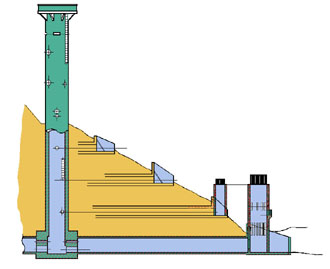
San
Pablo Outlet Tower is located about one mile upstream of the San
Pablo Dam in San Pablo Reservoir. It is a lightly reinforced concrete
cylindrical structure with just under one percent steel reinforcement.
At a total height of 109 ft, and 56 ft of embedment in rock formation,
only 53 ft of the tower stands above the ground surface. The cylindrical
San Pablo Tower is 10-feet in outer diameter and 7 feet in inner
diameter.
The
tower is modeled as two-dimensional (2D) beam-column elements
supported by lateral and vertical foundation springs along the
embedment depth. The interaction with the surrounding and inside
water is represented by added hydrodynamic mass coefficients.
Nominal concrete properties were used but the effects of lower
and upper bound material parameters on seismic performance of
the tower were also examined and were found to be negligible.
The rock properties were estimated based on observation and the
rock type at the site, and were used to compute the stiffness
of the foundation springs. Similar to concrete properties, foundation
spring values were also varied to assess their effects on the
seismic performance of the tower. Since the tower operates intermittently,
analyses were carried out with presence or absence of the inside
water to determine which case is more critical for the post-elastic
response analysis. The seismic input included two horizontal components
of acceleration response spectra, representing the MDE and the
84th percentile MCE ground motions. The estimated peak ground
acceleration for these events are 0.83g and 0.91g, respectively.
Envelopes of the maximum moments and shears were computed using
the response-spectrum mode-superposition technique and compared
with the corresponding section capacities.