Chabot
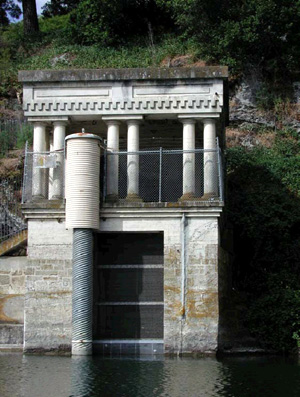
Tower is a multi-level entry portal structure constructed against
the Chabot Dam left abutment rock, on the west shore of Lake Chabot.
Inflow from the tower is passed to Tunnel No. 2 through an 8-foot-diameter
brick-lined outlet shaft behind the tower. The tower is approximately
23 feet square in plan and 48 feet tall. It is made primarily
of plain stone masonry and cast against the rock along its back
side and base with no anchors. At the top, the tower is capped
with a 13-foot high reinforced concrete pavilion. The pavilion
roof slab is supported on reinforced concrete perimeter beams,
which in turn are supported by 18 hollow circular concrete columns.
The pavilion is connected to the abutment rock through a concrete
slab bridge at the roof level.
Quest
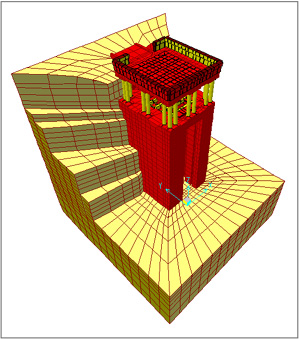
Structures performed three-dimensional finite-element analyses
to assess seismic performance of the tower for the East Bay Municipal
District under a contract to the URS Corporation. The seismic
evaluation was conducted for the maximum design earthquake (MDE)
and the maximum credible earthquake (MCE) ground motions. The
MDE was chosen as a ground motion having a 10 percent probability
of exceedance in 50 years (a return period of 475 years). The
MCE was estimated as a moment magnitude Mw 71/4
event on the nearby Hayward Fault 0.5 km west of the tower.
The
tower was modeled using 3D solid elements to represent the masonry
and a portion of the foundation and abutment rock that support
the tower. The pavilion was modeled using frame elements for columns,
shell elements for the roof slab, and 3D solid elements for beam
girders and the slab bridge. The inertia forces of the surrounding
and inside water due to earthquake shaking were represented by
added hydrodynamic mass coefficients. The tower was analyzed for
the gravity and hydrostatic loads plus the effects of seismic
loads. Three components of the earthquake response spectra were
applied as the seismic input. The seismic performance of the tower
was then assessed by comparing computed seismic force demands
with section capacities of the reinforced-concrete pavilion, and
seismic stress demands with tensile and shear strengths of the
plain stone masonry. Such comparison were employed to determine
the severity of damage and possible modes of failure from which
the probable performance and stability of the tower could be assessed.